Three and Out: How Not to Go to College
Going to college was the expected thing, of course, but I can’t recall discussing the topic with Dad or Mother. Dad, a doctor in a small east Texas town, was dying of drug addiction and heart disease, which made it difficult to focus on anything but him and his terrible problems.
But I do recall my decision to apply to Rice Institute, as it was known before changing to the grander name of Rice University. A friend boasted he was applying to Rice and I didn’t have the bona fides for admission.
That did it. I applied and soon was on track to take the SAT sometime after the Christmas holidays. Practice tests, tutors, study materials? No such thing existed in rural east Texas in the 1950s. I received a ticket in the mail with instructions to show up at St. Marks School in Dallas to take the test. I never learned my score.
Then came an interview. Memory is sketchy. Dallas on a pretty spring day. I wore a suit and chatted informally with two men.
A few weeks later I got a letter in the mail. “We are pleased….”
But the guy who put me up to it wasn’t accepted. Go figure.
So away I went from Hopkins County, where air conditioning was a rarity and dairy cows outnumbered people, to Houston, where homes were centrally air-conditioned and oil money outnumbered everything else.
Rice required students from small high schools like me to arrive a week early for remedial English and math. I felt at ease with the classes. I can handle this college business I reasoned, a notion that evaporated when the students from the big high schools showed up.
Back at home I was lord of a minor domain: captain of the football team, member of the National Honor Society, and possessed of a reputation for other small glories, all of which were gravel under the heels of my new well-shod classmates, who swarmed the campus with cool clothes, hot cars, and casual talk of European vacations.
That I was a rube became clear the first week of real classes when I was invited out for pizza. Pizza? I was a bubba from East Texas who didn’t know pepperoni from macaroni. I faked it and ordered a pepperoni like the guy in line in front of me. It was not just delicious; it was a revelation, the best thing I’d ever eaten, way better than steak at the Chuck Wagon Café on the town square. But it was unsettling. How could it be that I’d never heard of anything so good? I was at sea on a vast ocean that touched strange, distant shores. Never had I felt so lost.
The freshman year was hell. My performance on the first test in Physics 100 was but one tile in an expanding mosaic of misery. We wrote our answers in the standard little blue books. A week later a graduate assistant marched in and plopped the stack of graded blue books on a table at the front of the amphitheater and began calling out names. Up the rows they came, hand to hand. Privacy? Not a chance. One with “49” blazed on the front in three-inch numerals passed through my hands on the way to some unfortunate girl behind me. Well, she was a girl, and this was physics. Then mine arrived, handed up to me by a guy who glanced down at my score and then at me, looking as if he was staring at a corpse. Slashed in red beneath a column of single-digit scores for each answer was my grade: 21. Certain it was a mistake, I toted up the points. Sure enough, there was a mistake: my actual score was 11.
Worrying incessantly about money and Dad’s addiction and heart disease, first semester of my sophomore year was no better. Final exams were in mid-January. The results were desultory. In three semesters of exhausting work, I had accumulated 53 semester hours (the modern-day equivalent of about 17 courses) and all I had to show for it was 11 Cs and 4 Bs.
I must have been depressed. I suspect it was not the malignant variety that spawns suicide and requires anti-depressants, but a lesser ailment that today psychiatrists would call “Situational reaction with depression,” a soulless clinical term applied to unfortunates who are depressed because they have good reason: a failing marriage, bankruptcy, cancer, or being in over your head at Rice. It was all I could do to get out of bed each day.
Back in the 1950s every student lucky enough to be accepted was on full scholarship; we paid no tuition; we were just an expense. About 400 freshmen were enrolled each year, but only about 275 survived to graduate. Each of us was an expense, pure and simple; it was cheaper to flunk us out. ”No mercy” might well have been the financial office motto. “Root, hog, or die,” was ours.
In January 1957, the beginning of the second semester of my sophomore year, my dad entered an addiction treatment center about a mile from the Rice campus, so I saw him occasionally. He took me to a cafeteria once. It was awkward. In the course of our time together on the planet, we never had much to discuss because we were fighting separate battles: his to get narcotics and stay alive, mine to focus on anything else. We ate mostly in strained silence. He tried to cheer me up, but I could see he was dying: haggard and thin, his feet and belly swollen from heart failure, his eyes sockets of gloom. I felt sorry for him for the first time.
Then one bright day in early February he called to say he was being released because he’d been cured. I knew better. He asked me to drive him home. We got no further than Huntsville when he commanded me to stop as we passed a drugstore on the town square. He came out with morphine—he could convince anyone to do anything—and shot up right there in the car. That’s when I realized he would die soon. I saw him a few weeks later and he looked much better. Clean-shaven, pink-cheeked, mustache trimmed just so, gold-rimmed glasses glinting in the light, he was sporting a smooth Hickey-Freeman suit, pristine white shirt, and blue tie—resplendent in his casket at the First Baptist Church.
He died February 27, 1957. I was nineteen. “Born again” is a trite phrase, but in my case, it is true—freed of the weight of his existence, my grades shot up and I was named to the Dean’s List the first semester of my Junior year. I learned of the honor from a friend who told me he’d seen my name on the list posted on a bulletin board outside the Dean’s office. Thinking it was a joke and not wanting to lunge and be made a fool, I waited until the next day and sneaked over to have a peek. Sure enough, there was my name. There had to be a mistake: my grades were all Bs with one A. I asked the about the criteria and learned that the academic requirement was simple: no Cs in a semester.
Confidence soared. It had an unreal, heady feeling, this academic success where near failure had been the mode before. I decided to apply to medical school, hoping to be admitted after three years of college. Motivation was financial: Mother had moved to Dallas and was working as a hospital nurse. Shaving a year off would save a expense and let me get on with my medical career. However, I learned Rice had a policy that discouraged students from leaving to go to medical school after three years—after investing so much in us they wanted each of us to boast a Rice degree. To enforce their four-year/get-a-degree rule Rice forbade professors from recommending students to medical schools; instead, a pre-med committee wrote official letters.
But because I’d changed majors twice—from engineering to biology to psychology—I was accidentally on track to accumulate the necessary courses for medical school admission. But a problem became apparent—I couldn’t accumulate enough course credits to graduate in any field of study in four years, five would be required. Never mind that I was on track to complete 34 course credits (105 semester-hours) by the end of my junior year—nearly six courses per semester for six semesters.
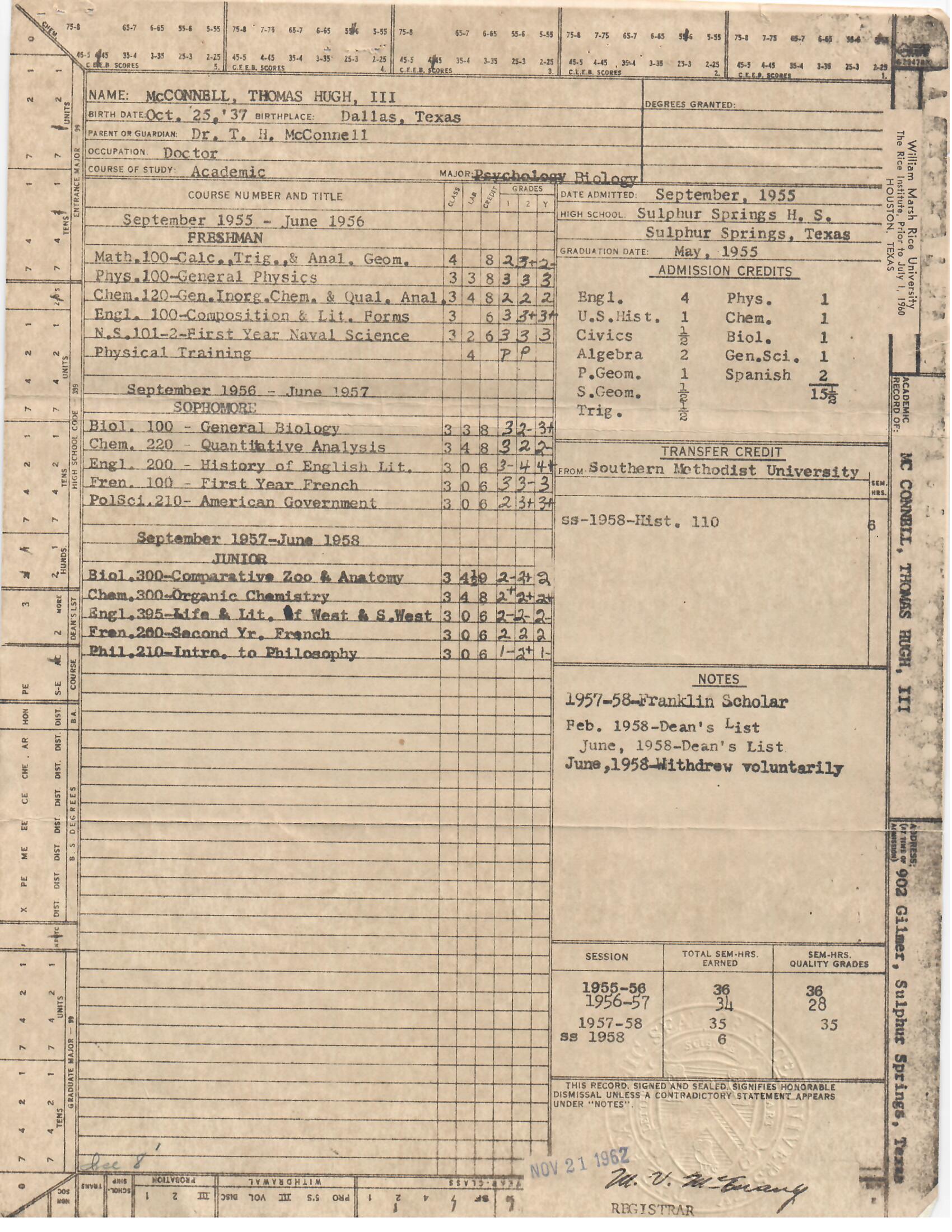
1 = A
2 = B
3 = C
4 = D
In three years a accumulated 105 semester hours
(16 year long courses, 32 if counting semesters)
I made one A and one D
My GPA was 2.5
I reasoned that it couldn’t hurt to take the Medical College Admissions Test, so I signed up hoping that I could find a way around my Rice problem. The test was hard and included two test booklets that left me blank: one on genetics and the other on art history. I set them aside to concentrate on stuff I knew more about, like biochemistry. Only after I’d turned in the test forms did I realize I’d forgotten about genetics and art history, leaving them on the floor beneath my chair. It was another low point. I never learned my score.
Thinking I must be a compelling exception to the rule preventing professor recommendations, I decided to appeal to Rice’s better angels. It seemed simple: my dad had died, Mother was struggling to make ends meet, and I had enough credits to satisfy UT Southwestern Medical School, the only choice if they would have me. I could afford UTSW because it was in Dallas and I could live with Mother. All I needed was for the Rice Premed Committee to waive their policy and recommend me. I sent a carefully composed letter to the Registrar and made an appointment.
A secretary ushered me into an office overlooking the Quadrangle, from which William Marsh Rice’s statue gazed benignly at me from the center of sculpted hedgerows.
“Take a chair, Mr. McConnell,” the Registrar said, pointing to my letter on this desk. “Let’s see if we can find a solution here.”
We exchanged a few pleasantries about the success of the 1957 Rice football team, which won the conference but lost to Navy in the Cotton Bowl. I had been to the game. Warming to my task, I laid out my case, carefully paralleling the points I made in the letter.
I made a special point of the fact that a senior faculty advisor approved my change of majors and course selections. Rice helped me get into this mess.
“Nevertheless, Mr. McConnell,” the Registrar said, “Rice policy is clear. Students bear final responsibility for their academic schedule.”
“But, sir, my father died eight months ago. He left us broke, and my mother is working to support my brother and me. I have all of the requirements for admission to UT Southwestern. It’s in Dallas and I can live at home. I can’t afford to spend four years here, much less five. I can go to medical school next year if UT Southwestern will take me.”
He leaned back in his chair, august and imperial. “Let me reiterate, Mr. McConnell. The bargain Rice University strikes with every undergraduate is this: We charge no tuition; you work hard and receive a free—I repeat, free—degree from a highly selective institution. Your benefit is obvious, ours less so. We measure our success by the number of people walking around with Rice diplomas. It’s that simple.”
“But, sir, that makes a Rice degree an end in itself. My education here is a means to an end—I want to go to medical school and I can’t afford to spend four years here, much less five, when a medical school might take me after three years.”
“You are not the first student to raise this issue. The University has a firm policy. The Pre-med Committee will not issue a recommendation for a student not on track to receive a degree at the next commencement. There is nothing I can do.”
He was the voice of Rice. He might as well have been God. I was 20 years old. Rice’s better angels were on vacation.
I was crushed. The only other thing I could think of to do was to appeal to several of my professors, whom I hoped would ignore Rice policy and recommend me directly, circumventing the bureaucracy. They knew me and my story. Maybe they would help. To their everlasting credit, each one of the four I approached agreed to write a letter on my behalf. By now it was the middle of the spring semester of my third year, well after most students had done their medical school interviews. Nevertheless, I made a trip to Dallas. After the usual pleasantries and talk about personal history, the professors interviewing me turned to serious scientific topics that left me throwing darts at answers. Seldom have I felt more ignorant and out of place. Afterward, I put my chances of admission near zero, but gave no thought to alternatives—I didn’t know what to do if they turned me down. But they didn’t.
Epilogue
Initially, I was angry about what I saw as Rice’s rigid, uncaring rejection of my plea. Surely, I thought, I must be the exception that proves the rule. In 1986 carried this grudge on board a Rice Alumni cruise to view Halley’s comet. One of the party was a retired Rice provost. I told him my story. He felt as I did, that I’d been done an injustice because my faculty advisor approved the course of study that left me unable to graduate in four years. He pursued my case, and engineered credit for some medical school courses so that I could be granted a Rice degree. I got the coveted and highly distinctive Rice ring in the mail. My diploma was printed, and I was told to show up for graduation ceremonies in May 1987. The day before I was to graduate the Faculty Senate rejected my application for a degree. Rice’s better angels were still on vacation. I sent the ring back.
Postscript
I tried again a few years ago and temporarily found a sympathetic ear but my contact stopped replying after an initial good start. Despite these disappointments, I love Rice. Marianne and I established a student aid fund, and I intend to leave more from my estate. I got a superlative and tuition free education. I am very grateful for it.
One final note: A Rice degree of any kind is a rare commodity. Undergraduate enrollment in my day was about 1200—about 400 admitted each year and 275 survived to graduate. And Rice grants no honorary degrees. It used to be true that fewer people had been granted a Rice undergraduate degree than were enrolled in the freshman class each year at UT Austin. Rice has expanded undergraduate admissions so that the student body is now about 3800. Rice has graduated about 48,000 undergraduates since its inception in 1912, so it’s not much of a stretch to say the total number to date is about the size of the student body at UT Austin.